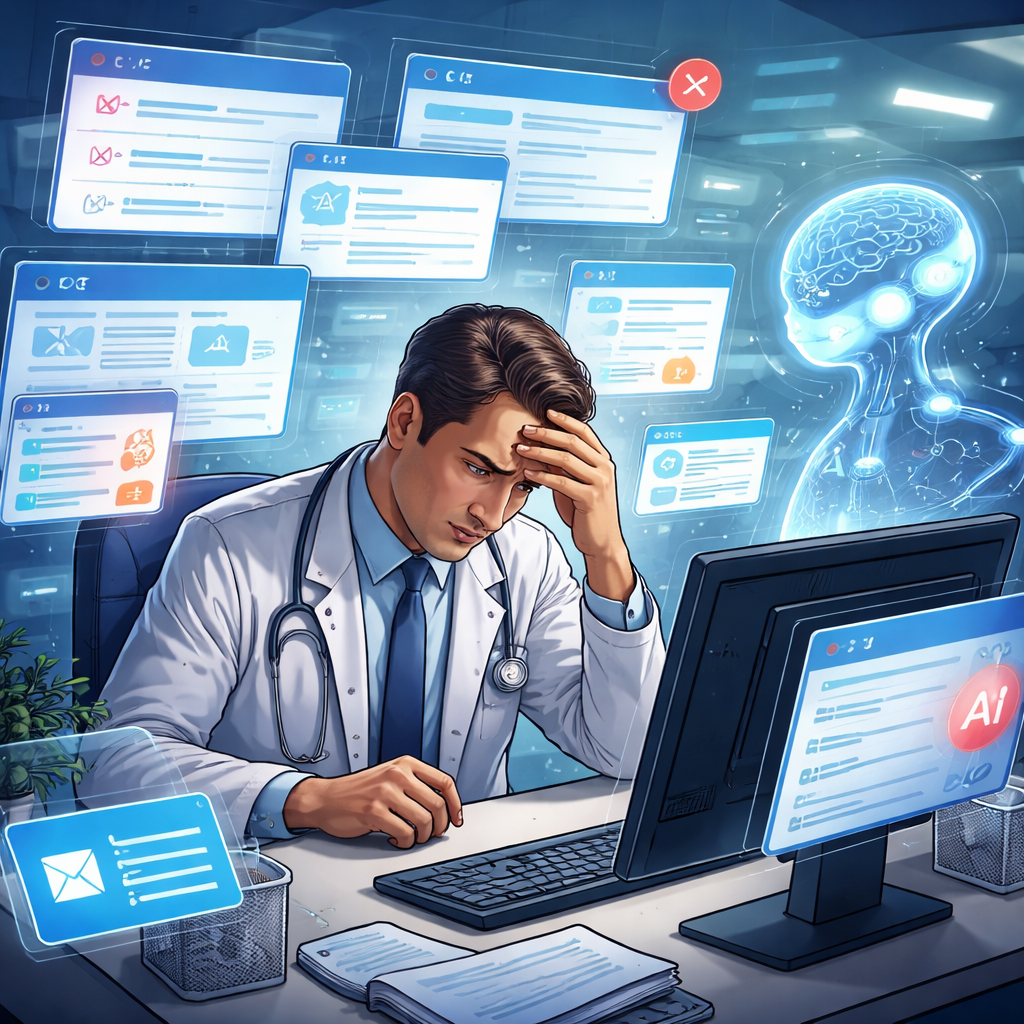
The problem isn’t the AI. It’s the integration strategy.
Clinicians in AI-enabled health systems are now receiving up to 200 alerts per day inside their EHR platforms. They override 96% of them.
That number should be disqualifying. Instead, it has become the accepted background noise of modern clinical operations. Health systems continue to invest in AI clinical decision support (layering alert upon alert, tool upon tool) while adoption rates stagnate and clinician burnout deepens.
This isn’t a technology problem. It’s a strategic failure of how health systems are deploying AI. And without a fundamental shift in integration philosophy, more AI investment will produce more of the same results.
The Three Failure Modes Driving Poor Adoption
The pattern is consistent and well-documented: AI deployed into the EHR, adoption stagnating, vendor promising the next release will fix it. It won’t. The root cause is almost never the AI itself. It’s the integration architecture. Three compounding failure modes are making it worse.
1. Alert Volume Is Not Clinical Intelligence
Rule-based clinical decision support systems were designed to fire alerts whenever a predefined condition is met. In isolation, it’s logical. At scale, it’s catastrophic. A single academic hospital ICU (66 adult beds) generated over 2 million alerts in a single month. That’s 187 warnings per patient per day.
The predictable consequence: approximately 90% of clinical alerts are now ignored due to chronically low signal-to-noise ratios. Clinicians have been trained, by the systems themselves, to click through. When a genuinely critical signal does arrive, it’s indistinguishable from the noise. Alert fatigue isn’t a clinician behavior problem. It’s a system design failure.
2. AI Built Around the EHR, Not the Clinician
Most EHR-native AI tools are designed around the vendor’s data model, not around how clinicians actually navigate patient care. The result is workflow friction: recommendations delivered in a secondary interface that must be manually reconciled with clinical judgment, or alerts that require navigating away from the active patient chart at precisely the moment cognitive bandwidth is highest.
A 2024 JAMIA systematic review of AI-CDS deployments found that “workflow disruption” and “additional cognitive load” rank as the top two adoption barriers among frontline clinicians, cited ahead of accuracy concerns, cost, and training gaps. Clinician resistance to AI tools isn’t irrational. When a tool adds steps without adding proportional decision quality, rational actors stop using it.
Worth naming directly: most EHR-AI tools are designed to solve vendor retention problems, not clinical workflow problems. The EHR vendor selling the AI add-on is largely the same vendor whose alert architecture created the override problem in the first place. If your AI roadmap was built in partnership with your EHR vendor alone, that’s a risk factor worth auditing, not a strategy.
3. Black-Box Outputs Destroy Clinical Trust
The most underappreciated failure mode is opacity. Deep learning models can achieve impressive accuracy metrics in controlled environments. But when a clinician receives a recommendation with no underlying rationale, no data inputs, and no confidence level, they face an untenable choice: trust it blindly or ignore it entirely.
A 2025 systematic review found that algorithmic opacity and insufficient transparency are the leading drivers of clinician distrust in AI-CDS: not accuracy, not cost, not implementation timelines. Healthcare professionals won’t stake patient outcomes on a recommendation they can’t interrogate. This isn’t resistance to innovation. It’s professional accountability.
The Strategic Insight: Integration Philosophy Determines ROI
Health systems generating measurable, sustained ROI from AI clinical decision support aren’t deploying better algorithms. They’re deploying AI differently. Three structural characteristics define high-performing implementations.
Native Embedding, Not Bolt-On Deployment
Effective AI doesn’t ask clinicians to go somewhere else. It operates inside the active clinical workflow: in the medication order panel, inside the care gap notification, within the progress note. The diagnostic question to ask any EHR-AI vendor is direct: does your tool require the clinician to leave their current screen to act on a recommendation? If the answer is yes, the friction point has already been identified.
Predictive, Patient-Specific Intelligence, Not Rule-Based Alerts
The shift from static, rule-triggered alerts to machine learning models that contextualize recommendations against a specific patient’s history and current trajectory is the single most impactful change a health system can make.
“This drug class has a renal dosing warning” is a reference tool. “This patient’s eGFR trajectory over the past 72 hours suggests a 34% probability of acute kidney injury at the current dose” is clinical intelligence. The former generates noise. The latter generates action.
Explainability as a Clinical Requirement, Not a Regulatory Checkbox
The most effective AI-CDS deployments treat explainability as a core clinical capability: surfacing the data inputs, confidence intervals, and evidence basis behind every recommendation in a format clinicians can evaluate in under 30 seconds. This creates something rule-based systems never could: a feedback loop where clinicians interrogate, override with documented rationale, and improve AI outputs over time.
Explainability isn’t a UX nicety. It’s the mechanism through which clinical AI earns and maintains institutional trust.
Audit Your Current Deployments: A Four-Metric Framework
Before allocating new budget to AI capabilities, healthcare leaders should audit what they already have deployed. Four metrics reveal whether an existing AI-CDS investment is generating intelligence or generating noise:
Alert Override Rate: Target below 30% for high-priority alerts. Above 50% is a signal-to-noise failure. Above 70% means you’re generating noise.
Workflow Integration Depth: A clinician should be able to act in two clicks or fewer from their active screen. More than two clicks is a design failure.
Explainability Score: A clinician should be able to understand the rationale behind a recommendation in under 30 seconds. If they can’t explain it, it’s a black box.
Outcome Attribution: What percentage of alerts led to a documented clinical action? No tracking means no governance and no path to improvement.
If your organization lacks data on any of these metrics, that’s itself a governance gap that precedes any technology investment decision.
The Bottom Line
A 96% override rate is not a compliance problem, it is evidence the integration strategy failed at the design stage, and buying better AI without rebuilding the workflow will not move that number. The health systems that can produce their override rates inside 48 hours are the ones that already know where the seam broke. The rest have a governance gap no new purchase will close.
The dividing line in 2026 vendor evaluations is whether a tool works inside a live clinical workflow or only inside a polished sales demo. The integration seam is where most AI deployments fail, and a sandbox demonstration is built precisely to hide it. The systems that insist on seeing the tool run in their own workflow are the ones who find the friction point before they sign.
Explainability is where the exposure concentrates. A vendor that can’t document what inputs drive each recommendation, how confidence is calculated, and how the model performs across patient demographics isn’t enterprise-ready, and the operators who treat that documentation as optional inherit the model’s blind spots as their own.
“A 96% override rate isn’t a compliance problem. It’s evidence that the AI integration strategy failed at the design stage, and buying better AI without rebuilding the workflow won’t move that number.”
“A 96% override rate isn’t a compliance problem. It’s evidence that the AI integration strategy failed at the design stage, and buying better AI without rebuilding the workflow won’t move that number.”